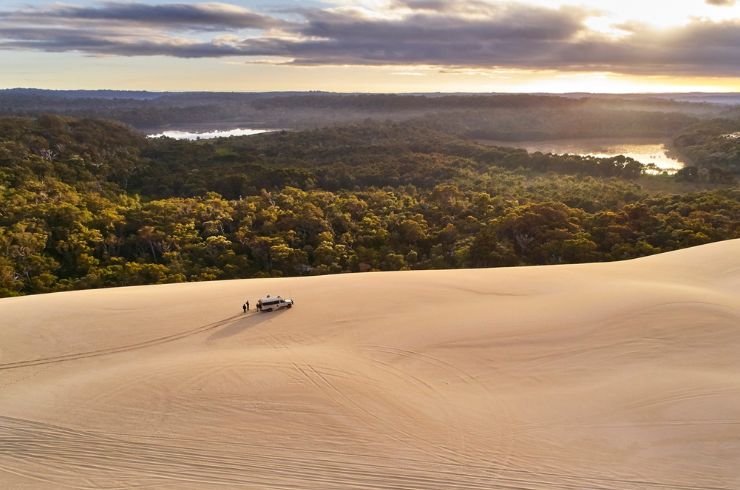
It’s easy to shelve the idea of visiting Frankland River, popping it into the too-hard-to-visit basket somewhere on the fringes of Western Australia’s wine map. But with the inaugural Frankland River Wine Festival as a catalyst for my visit, it took only a few days to unravel that perception.
Part of the Great Southern, and a registered GI since 2001, Frankland River’s landscape is expansive and characterised by open, sometimes sparse stretches of land, a tapestry of canola, cereal and grain crops (the region is a major global exporter of specialised noodle wheat, tailored for Japanese udon and Asian markets), and pockets of bushland where wildflowers, particularly native orchids, are quite literally sewn into the roadside. Shiraz and riesling are pillars of regional expression, but there is plenty of diversity planted in its deeply coloured red and ironstone soils.

The Roche family established Frankland River’s first vineyard, originally named Westfield, in 1968, and it’s cycled through a few names over the last near six decades, but is now known as the Justin vineyard and is owned by Houghton Wines (Vinarchy). Merv and Judy Lange began developing Alkoomi shortly after, in 1971, followed by Barrie Smith and Judi Cullam, who planted Frankland Estate in 1988, establishing a single-vineyard riesling and shiraz specialist program. Family connections remain central to the region, with succession plans in place for the second and third generations, adding security not only to the vineyards but also the region's community.
Swinney is one such family endeavour, with an impressive operation of deep roots: 160ha planted to varieties including magnificent bush vine mourvèdre, shiraz and grenache, each forming the backbone of their esteemed Farvie collection. At Cherubino’s nearby 80ha Riversdale vineyard, the focus is on emerging varieties, with mencía, fiano, greco, nebbiolo, grüner veltliner, touriga nacional and counoise showing strong suitability to the cool river valley climate. An ambitious portfolio by all accounts, but does that really surprise anyone who knows Larry Cherubino?

Frankland Estate needs little introduction; it’s a second-generation family operation led by siblings Hunter and Elizabeth (Lizzie) Smith, alongside Elizabeth’s husband, Brian Kent, who has guided winemaking since 2010. Its wines are making an impact that transcends WA. Mike Bennie recently reviewed the Frankland Estate Alter Weg Organic Riesling 2025 and gave it 97 points. A compelling expression, barrel-fermented and lees-aged, with a textural complexity that takes Australian riesling to roads less travelled. The Frankland Estate FRANC Organic Cabernet Franc 2025 (95 points) is equally impressive, balancing red-fruited freshness and fine tannins. Both also received special value recognition.
Ferngrove offers another lens on the region’s pioneering spirit. Established in 1998 by Murray Burton, Merv Lange and Ted Avery, the estate boasts an incredible commercial winery, though much remains unused, as corporates increasingly pull out of the region and reduce demand for fruit processing. A barrel-blending exercise exploring chardonnay across the portfolio, from the flagship Stirlings range through to the mid-tier Orchid and Estate wines, was a highlight of my visit. It offered a fascinating insight into the interplay of oak and clone, and how seemingly subtle variables shape the finished wines.

Pruning at Alkoomi was an unexpected pleasure, and I willingly put my hand up for any producer who needs free labour; the outdoor monotony was incredibly soothing, albeit under less-than-ideal circumstances. Frankland River had a significant frost event the week of my arrival, and we worked to cut away frost-affected shoots before an incredible museum tasting, which made a strong case for the region’s cellaring potential.
Dining can be something of a challenge, which perhaps explains why the locals are such fiercely capable cooks. Just try Lizzie Smith’s rendition of a Ferrero Rocher; she also muscles up a mean hasselback potato. There isn’t much in the way of a town centre; an op shop (closed during my visit) and a general store are about the extent of it. But do make time for the Lange Estate cellar door (the Fifth Generation Riesling is a must-try). The region also produces excellent olive oil, and I arrived home with several bottles from different producers.
Frankland River may feel a little off the beaten track, and it’s certainly far from being a tourism hotspot, but as Julie Zambra from Ferngrove puts it, “It’s really the centre of everywhere”, and its wines and humble hospitality offer plenty of reason to make the journey.
Top image credit: Frankland Estate
Latest Articles
-
Behind the label
An Ode to Elderton
1 day ago -
Travel
Seven New Zealand cellar doors with incredible guest experiences
1 day ago -
Wine Lists
Check out these 14 newly-reviewed Australian wines; they won't disappoint
1 day ago -
Travel
Exploring the Adelaide Hills? Here are three must-visit wineries
2 days ago