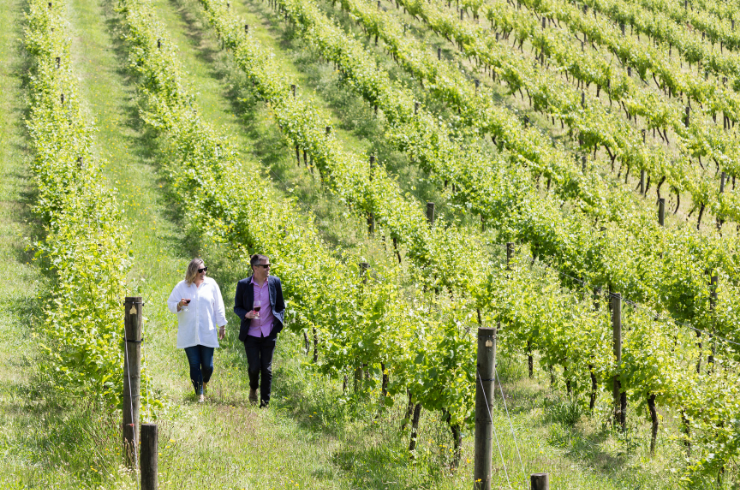
It’s been half a century since Pat Carmody planted shiraz at Craiglee in Sunbury, on the outskirts of Melbourne. Jane Faulkner spoke to the vigneron about the milestone and what the future holds for the historic site.
Instead of a glass of Craiglee shiraz, vigneron Pat Carmody has poured me a cuppa, albeit a very good one. It’s been a few years since I’ve visited him in Sunbury, barely 40 kilometres north of Melbourne’s CBD, a special place where time stands still. The turnoff is harder to find now, and the property sits low, hidden from the bustling roadway, almost swallowed by suburbia, burgeoning around.
I’m here because 2026 marks 50 years since Pat planted shiraz, signalling the renaissance of the historic site, which was once home to a significant vineyard that produced award-winning wines in the 19th and early 20th centuries.
So, when’s the birthday party? “I’m not having one,” he says, bluntly. “There have been a couple of deaths, and it makes you rethink things.”
He’s referring to a friend he’d known for 40 years, plus industry colleagues including Nat White, who set up Main Ridge Estate on the Mornington Peninsula, and Lillydale Estate co-founder Alex White (no relation), who influenced many Victorian wineries. A touch rattled, Pat is all too aware of the fragility of time. Yes, he’s sharp and fit but works alone, except for his wife, Dianne, an excellent pruner, who’s there to support. The sticking point – there is no succession plan. Their two sons have a nostalgic attachment, but their own lives and careers. No one is waiting in the wings.
“I can see myself doing this until I’m 75, which is next year, but I can’t see myself making wine at 80,” he says. Given he holds back his shiraz and is on the cusp of releasing the ’22, that means there are four more vintages in the pipeline. “Even if I stop now, I’ll still have wine to sell until I’m 80!”

It’s also a pivotal time in the vineyard, as the golden jubilee vines need to be reinvigorated, preserved and their DNA assured, which means taking cuttings and replanting. He can’t do it himself. Can’t justify the cost, either. “It’s a hard one. I don’t know what the outcome will be as we both quite like living here, but for how long? I don’t know.”
What will happen to Pat’s beloved Craiglee weighs heavily. Nonetheless, this year marks a milestone – half a century devoted to growing cool-climate, medium-bodied, spicy shiraz.
Pat’s farmer parents, Theresa and Pat senior, bought the significant Sunbury property, then covering some 202 hectares, from the Johnston family in 1960. While a bare paddock ignobly covered the original vineyard, its link to Victoria’s, and indeed Australia’s, early winemaking history remained, bearing witness to it all and standing proud: the gravity-fed, four-storey bluestone winery. Now heritage listed, it was built between 1865–1868 for then-owner, the entrepreneur and Victorian politician James Stewart Johnston (Johnston Street in Collingwood is named in his honour). Scottish born, he coined Craiglee and made arguably its most famous wine, the 1872 Shiraz.
There was no wine in the cellar when the Carmody family moved in; Johnston’s heirs had offloaded it all through the highly regarded wine merchant Tom Seabrook barely a decade earlier. Thankfully, those who bought the prized bottles held decent cellars, and serendipitously, a bottle made its way to a dinner two decades later. That wine, and its story, would irrevocably change the trajectory of Pat’s life and initiate the rebirth of Craiglee.
John Brown, second generation of the Brown Brothers family, had the fortune of being at this dinner where the 1872 Craiglee Hermitage, as it was known then, was poured. He was gobsmacked. A wine, 100 years old with so much to say, and still very much alive. He drove to Craiglee the next day.
“John found his way out here – which I thought was amazing, as there was just a small sign at the gate – and came in and introduced himself,” said Pat. “He said any site that can produce a wine lasting 100 years has to have something special going for it.”
That statement resonated with the young farmer. It planted the seed of change, which took hold a few years later. “Dad was kind enough to let me have a go and said, ‘Good luck, the paddock’s there’. He was 62, so he was on the edge of retirement. I was working here and had nothing to lose.”
In ’76, two hectares of shiraz went in, and the following year, 1.6-hectares of chardonnay. The revival had begun and the magnificent bluestone winery, unused for three decades, was about to come back to life. Today it’s the cellar door.

In 1979, he harvested the first crop, making 18 dozen bottles. The first commercial release the following year turned out a few hundred dozen. It took another seven years “for our first dollars” to come in.
Pat’s mum asked how long he would last as a winemaker. “I told her 15 years sounds fair,” he recalls. “I couldn’t conceive I’d be here 50 years later. I’m surrounded by suburbia and I thought the place would be subdivided; I couldn’t imagine the vineyard still being here.”
Australia has been very slow to identify or adopt the idea of what industry leader Brian Croser calls distinguished sites. Even though the original vines were pulled out in the 1940s, the Craiglee site is still stamped with the same shiraz terroir that produced the famed 1872. “The great vineyards of the world are single sites” he says, and by extension, produce the finest wines.
Thing is, it can be a curse to be wedded to one place. The vagaries of vintage can hit harder; Craiglee has been hit by frost again, and Pat is not enjoying pruning the vines to ensure they spring back to life. But this is his lot in life.
“Some people stupidly describe me as humble. If you are making wine, you’re not humble. You’re putting yourself on the line all the time. If you put your name to a bottle, and yeah, I can be flippant about it, but really, there is significant pride in that.”
Still, he doesn’t blow his own trumpet – not even a piccolo. I remind him that Craiglee is admired, loved and respected, his shiraz especially is so distinctive.
As Michael Dhillon, from nearby Bindi, says: “Pat has long been a constant and a beacon of high-quality, cool-climate, medium-weight shiraz. Craiglee is an important vineyard, winery and producer, and Pat is the classic exemplar of the truest facts and outcomes in viticulture and winemaking made worthy by time.”
He has proved “that very rare thing of longevity and sustainability,” Michael adds, “and as with the likes of say Mount Mary, Cullen, all icons, Craiglee is also an icon.”

You might be wondering if Pat ever tasted the 1872 Hermitage. Only once. Andrew Wood, publisher of the now-defunct Divine magazine, bought probably the last bottle at auction among a series of extraordinary old wines (including a 1915 Yeringberg cabernet) and hosted a dinner at the National Trust mansion, Labassa in Caulfield on 13 February 1992. He invited Pat.
“Although I didn’t know what I was looking for in a 120-year-old wine, it still had colour and some semblance of fruit,” Pat says.
James Halliday, who was also there, wrote: “The bouquet initially had faint dead gum leaf/dry grass scents allied with a hint of mint; spice came up next, very complex cardamom spice. Structure very good; likewise good finish.”
Closing the wood doors of the old cellar, in the shadow of an enormous Moreton Bay fig and just beyond a towering oak, both well into their second century, Pat signs off by saying: “I am very proud to survive in farming, but it has always been about this place, and for those wines to have survived for 100 or more years is the testament. Although I feel like a bit of a fraud because I didn’t start anything new, I just hope I’m producing something of quality that will last across time. It is good fun though. All good fun.”
Passing by his beloved rose patch on the way out, I shout out I’ll be back next year for the 50th chardonnay celebration, and again in 2029 for the other milestone, 50 years since the first Craiglee shiraz was harvested. Long may it continue.